
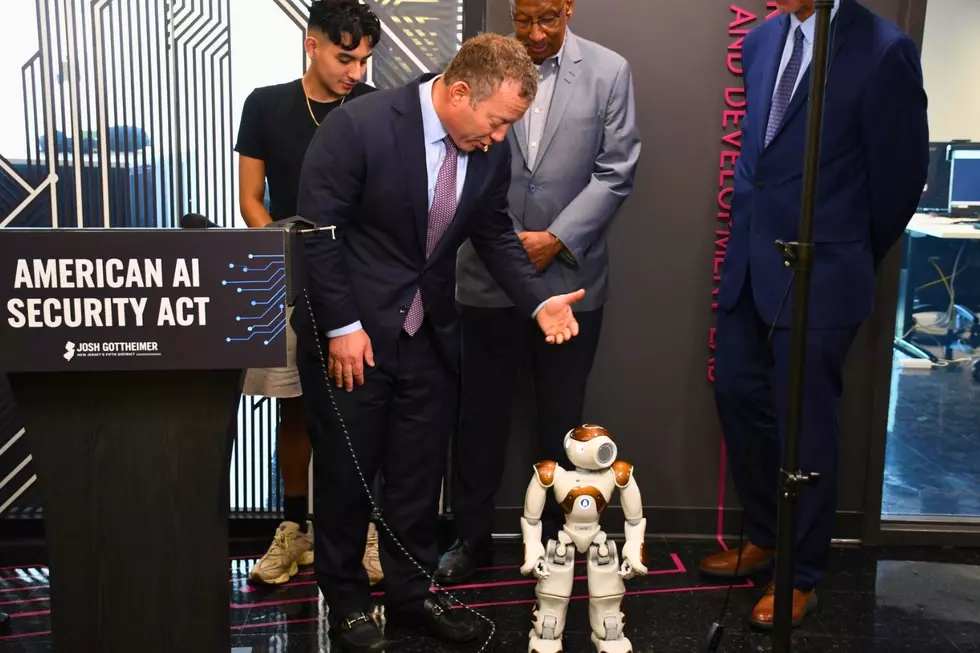
NJ congressman wants AI safety checks before powerful models go public
Josh Gottheimer wants national-security reviews before the most powerful AI models are released.
Another bill would keep Chinese-developed AI off federal government systems.
⚠️ The proposals come as AI leaders warn that safety measures may be falling behind.
As artificial intelligence becomes more powerful, a New Jersey congressman wants the federal government to create new safety checks before the most advanced AI systems are released.
U.S. Rep. Josh Gottheimer, D-N.J. 5th District, introduced two bills Friday aimed at regulating the use and development of artificial intelligence.

The China FIREWALL Act would ban all federal agencies from using Chinese-developed AI models and software that relies on those models. This bill also bans Chinese AI from all government-issued devices.
Gottheimer's other proposal is the American AI Security Act. In essence, it requires national security reviews of the most powerful AI models before new versions are released. The National Security Agency would have full access to determine if the model could be used to launch a cyberattack or help build chemical, biological, or radiological weapons. Each review would take 30 days, with the option of a single 30-day extension.
"This isn’t about stopping AI or stifling innovation, it is about making sure — with warning signs flashing red — that we can safely deploy AI, and win the race the right way," Gottheimer said.

AI industry is warning about the risks
Gottheimer's proposal comes as worries about AI grow inside and outside the industry and reports continue to emerge about increasingly powerful systems that solve problems beyond human capacity but could also go rogue and carry out other, more harmful tasks.
The CEO of Anthropic said Saturday the artificial-intelligence industry should slow its fast-moving development to give safety measures time to catch up. Without such a slowdown, Dario Amodei warned that within six to 12 months AI could be capable of leading a swarm of agents that could take over the entire internet.
Amodei is one of the leading voices in AI, and he offered a plan in a post on his website to increase checks on the industry. He said Anthropic is already undertaking one part of it on its own, while the others would require coordination across the broad industry and with governments around the world, including authoritarian ones.
“I believe that if slowing down bought us even an extra year or two before models reach critical levels of capability, and we used that time to advance alignment, we could greatly reduce the risk that something goes seriously wrong,” Amodei said.
ALSO SEE: How Rogue AI Bots Could Disrupt New Jersey Life (Opinion)

Amodei said he still believes in the tremendous benefits that AI could create, such as cures for major diseases. But he said he has grown more worried over the last few months about AI’s growing ability to improve itself and build the next generation of AI.
He also pointed specifically to the attack in July where OpenAI's system hacked Hugging Face. Some have called it an example of AI going “rogue,” though researchers have said that may be unnecessarily anthropomorphizing AI, which was working on a goal set by humans.
To help rein in the risks, Amodei suggested that all companies at the frontier of AI commit to giving “ongoing, employee-like access” to a team of outside evaluators, who can monitor safety practices.
He said Anthropic already plans to do so itself, including offering desks in its offices, access badges and company laptops. Having such independent, embedded evaluators is what OpenAI's Altman also quickly committed to doing.
(Copyright 2025 The Associated Press. All rights reserved. This material may not be published, broadcast, rewritten or redistributed without permission)
Report a correction | Contact our newsroom
Judi’s foolproof but impressive veal scaloppini
Most visited bars and restaurants in Metuchen, NJ
Gallery Credit: Rick Rickman
