
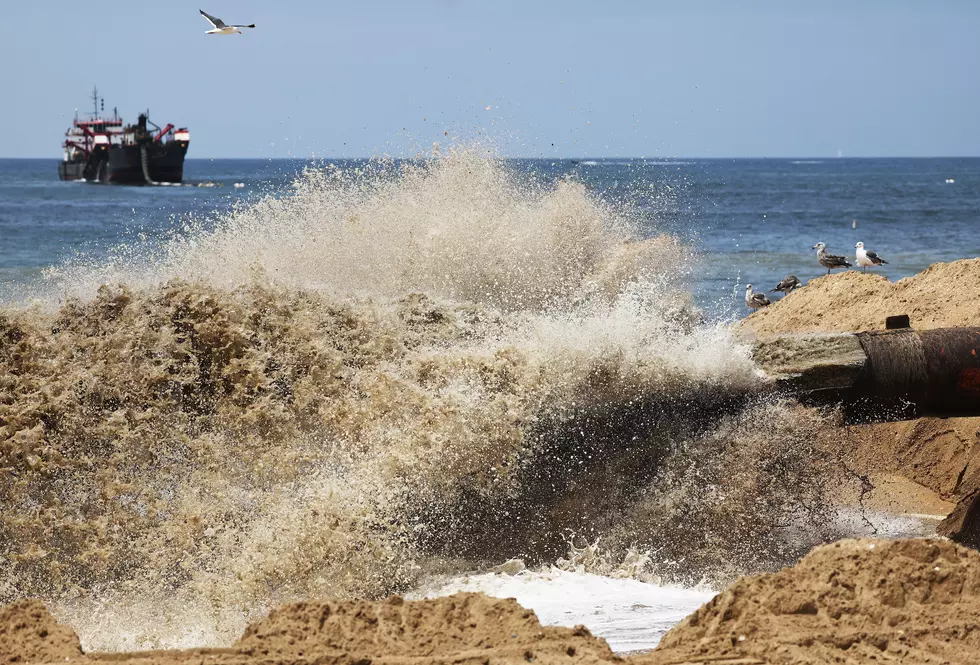
Beach replenishment is futile — so why must we keep doing it?
Sea Isle City just finished getting a new beach. Ocean City and Strathmere are still in the middle of getting theirs. And this winter, Long Branch is going to do the entire thing over again. Watch this pattern long enough and a fair question starts to form: if the ocean is just going to take the sand back in a few years anyway, why do we keep paying to put it there?
It's not a small amount of paying, either. The Army Corps of Engineers are completing a $19.5 million project pumping 1.6 million cubic yards of sand onto Ocean City's beaches. Sea Isle City's own fill, finished last month, placed 479,000 cubic yards between 29th and 55th Streets. Strathmere is getting a dune system built out 400 feet, replacing an 11-foot dune that had disappeared entirely, part of $99 million in federal funding U.S. Rep. Jeff Van Drew, R-2nd, announced for Ocean City, Strathmere, Sea Isle City, Avalon, and Stone Harbor combined. And now U.S. Rep. Frank Pallone, D-6th, has announced a $37 million project targeting Monmouth Beach, Sea Bright, and Long Branch, expected to start late this fall and wrap by March 2027.
Even the mayors doing this work will tell you it doesn't fix anything permanently. Upper Township Mayor Curtis Corson, watching his own town's dune rebuilt from scratch, pointed out that Ocean City has hard structures all along its north end and still deals with erosion. If seawalls and jetties don't stop it, and pumped sand washes away on a four-to-seven-year cycle depending on the stretch of coast, "futile" isn't an unfair word for what's happening here.
SEE ALSO: The sand is finally moving again on Ocean City's beaches — here's the update

So why do we keep doing it?
Because the number underneath the sand is bigger than the sand itself. New Jersey's tourism and visitor economy generated $24.7 billion in GDP in 2024, about 2.9 percent of the entire state's economic output, and supported more than 507,833 jobs, roughly 1 in every 12 jobs in the state. Visitor spending alone hit $50.6 billion that year. Widen the lens to leisure and hospitality, the broader category tourism sits inside of, and you get $32.7 billion in state output and 402,600 people employed. For comparison, health care contributed $65.3 billion to New Jersey's GDP that year, manufacturing $70.9 billion, and finance more than $54 billion. Tourism isn't the biggest of those. But it's not far off, and it's a lot closer to the state's true economic engines than the casual "New Jersey's number one industry" label usually gets credit for, especially once you're counting jobs and tax revenue instead of just GDP. One 2023 analysis even ranked the visitor industry, on its own, as New Jersey's ninth-largest employer, with about 329,000 direct jobs.
That's the actual math behind every one of these projects. A beach isn't just sand. It's the reason someone rents a house in Ocean City for a week, eats at a restaurant in Strathmere, buys a beach tag in Sea Isle City, books a hotel room in Long Branch. Replenishment doesn't need to last forever to be worth doing. It needs to hold long enough for that economy to keep running, one more busy season at a time, until it's time to pump the sand back in and do it again.
Futile, maybe, if you're measuring it against the ocean's patience. But measured against $24.7 billion and half a million jobs, it starts to look less like a losing fight and more like the cost of staying in business.
CHECK OUT: All the free beaches in New Jersey
